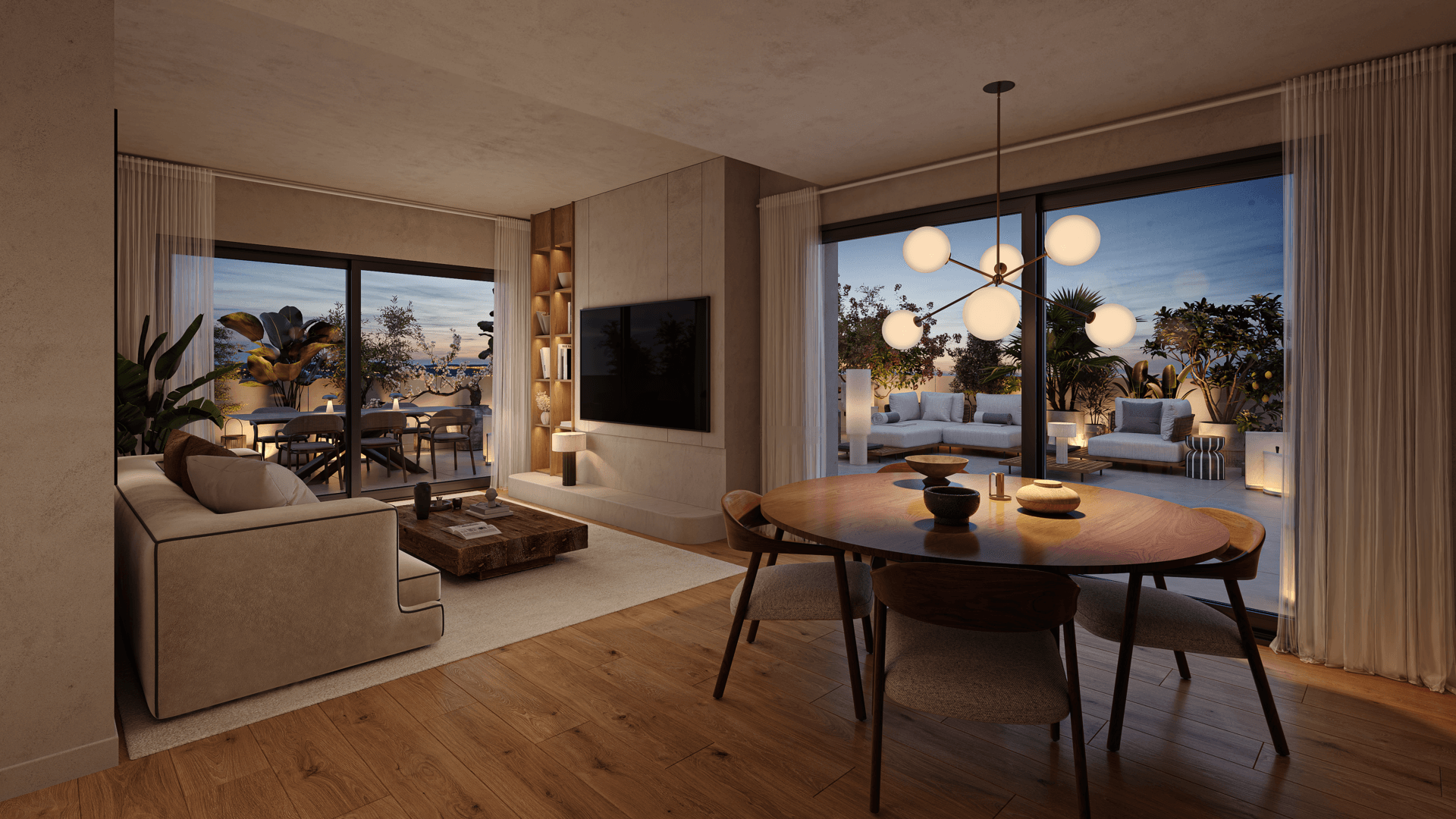





Top-floor apartment: who is it a good choice for?
A top-floor apartment is a good choice for people who value privacy, light, and an open view, but only if the building has a solid roof, effective insulation, and a reliable lift. The location of the apartment alone does not determine either comfort or costs.
On the top floor, you can benefit from peace and quiet from above as well as better access to sunlight. At the same time, you need to realistically assess the roof, summer cooling, winter heating, and how the lift operates. It is not a floor for everyone, but in a well-designed development, it can be one of the most attractive options.
The main advantages of a top-floor apartment
The greatest advantages of a top-floor apartment are privacy, no neighbour above the ceiling, more light, and often a more open view. An apartment on the highest floor works particularly well where buildings are spaced at appropriate distances and the windows do not face a busy street or the technical facilities of a neighbouring property.
More privacy and no neighbours above you
Having no apartment above means less impact noise. You do not hear footsteps, chairs being moved, objects falling, or children running across the floor upstairs. For people who work from home or are sensitive to sound, this is often a more important argument than the view itself.
However, you should not expect complete silence. Sounds can still travel through walls, plumbing risers, ventilation, and the stairwell. During a viewing, it is a good idea to stop talking for a few minutes, open the window, and then listen to the apartment again with the windows closed. This simple test says more than a seller’s assurance about a “quiet neighbourhood.”
Views, daylight, and a sense of space
A higher floor usually offers a better chance of an open panorama and less shading from neighbouring buildings. Natural light can noticeably change how the size of an apartment is perceived: a living room with large glazing and a view of greenery or the city feels more spacious than a similar ground-floor property.
However, a view should not be treated as a feature guaranteed for years to come. Before buying, you should analyse the surroundings, undeveloped plots, and planning documents available for the location. If a taller building is planned next door, today’s panorama may disappear in the future.
Less dust and street noise - but not in every location
On higher floors, direct dust from the pavement, exhaust fumes, and conversations of passers-by are often less noticeable. This is an advantage especially in dense urban areas, where ground-floor apartments are close to the street and pedestrian traffic.
This does not automatically mean a lower noise level. Sound from a major road, railway line, or restaurant terrace can carry upwards, and wind can amplify it. In resorts and new residential developments, you should also pay attention to fans, air-conditioning units, or other equipment placed on nearby roofs. Viewings in the morning and evening, with the windows open, allow you to assess this issue fairly.
Disadvantages and risks of a top-floor apartment
The disadvantages of a top-floor apartment mainly concern temperature, the roof, the lift, and access to the property. Problems with top-floor apartments are not inevitable, but resolving them can be expensive, so the technical condition should be assessed before signing a contract.
The greatest caution is needed when the property manager does not provide information about leaks and roof repairs, and there are signs of dampness or freshly painted patches on the ceiling. Such an apartment should be rejected regardless of its attractive price until an independent inspector explains the cause.
Higher summer temperatures and cooling costs
The roof receives intense sunlight, while large glazed areas can additionally heat up the interior. The most difficult scenario is a living room facing west or south-west, with large windows and no external sun protection. In warm climates popular among holiday apartment buyers, summer comfort should be one of the key purchase criteria.
You should establish how the roof insulation was installed, whether the windows have suitable heat-reducing properties, and whether the building allows air conditioning to be fitted. External roller shutters, façade blinds, and terrace shading work more effectively than interior curtains alone. Energy costs depend on the building standard, usage patterns, and air-conditioning settings, so they cannot be reliably assessed based on the floor alone.
Heating, the roof, and the risk of dampness
The top floor is located directly beneath the roof, so the condition of the roof covering, waterproofing, insulation, and drainage affects heat loss and the risk of dampness. A leak is not a feature of every apartment under a roof. However, it is a sign that the technical documentation must be checked more thoroughly than for a lower-floor property.
You should obtain information from the developer or property manager about the roof warranty, repairs carried out, residents’ complaints, and planned renovations. In a building managed by a homeowners’ association, meeting minutes and information about the repair fund – funds collected for future repairs to common areas – are useful. If the roof requires urgent modernisation, a low apartment price may quickly stop being a bargain.
Lift, stairs, and everyday accessibility
A lift breakdown on the second floor is inconvenient. On the eighth or tenth floor, it can completely change your daily routine. A family with a pushchair, an older person, someone recovering from an injury, or a resident returning with large grocery shopping will feel this problem immediately.
During a viewing, it is a good idea to walk the route from the entrance to the apartment using the stairs. It is also worth determining the number of lifts, maintenance frequency, and whether one lift is large enough for a pushchair, bicycle, or larger parcels. When buying an investment apartment, you should also think about guests and tenants: difficult access may affect their experience, even if the apartment itself is attractive.
Moving in requires separate verification. Some buildings have restrictions on using a service lift, delivery hours, or transporting large furniture. It is a detail that is easy to overlook before buying.
Terrace, balcony, and noise from rooftop installations
A top-floor terrace can be a major advantage of an apartment, especially in holiday apartments and penthouses. It provides a private space for relaxation and, with good orientation, an attractive view. At the same time, its waterproofing and drainage require more attention than a standard balcony.
You should inspect the drains, surface gradients, finishing around the terrace doors, and the condition of the ceiling in the room below the terrace. You should also review the homeowners’ association rules: they may specify requirements for installing pergolas, screens, air-conditioning units, or using a barbecue.
The location of technical equipment is important. Lift machinery, fans, cooling units, or rooftop installations can create a constant hum or vibrations. It is best to view the apartment while these systems are running, rather than only during a quiet part of the day.
Top floor in older and newer buildings - what should you compare?
A top-floor apartment in a block of flats should be assessed differently in an older townhouse building, differently in a prefabricated concrete-panel building, and differently again in a new development. A top-floor apartment in a new building often benefits from better insulation and modern ventilation, but the quality of workmanship still requires a technical inspection.
|
Criterion |
Older building |
New development |
|
Roof |
Repair history, age of the covering, signs of leaks |
Warranty, construction documentation, quality of handover inspection |
|
Insulation |
Condition of ceiling and wall insulation |
Insulation specifications and thermal bridges |
|
Lift |
Availability, reliability, upgrades |
Number of lifts, maintenance, cabin dimensions |
|
Ventilation and cooling |
Condition of ducts, possibility of air conditioning |
Type of ventilation, installations, approvals for equipment |
|
Fees |
Repair fund and planned investments |
Administrative costs and common areas |
|
History of defects |
Homeowners’ association minutes, residents’ reports |
Inspections, complaints, and warranty period |
What should you check in a new development?
In a new building, the prospectus, technical specification, and visualisations do not replace an inspection. During the handover, you should compare the declared solutions with the actual condition of the apartment: window orientation, quality of window installation, acoustic insulation, ventilation, and terrace access.
Information about the roof and technical equipment is particularly important. If fans or elements of the cooling system are located directly above the bedroom, comfort may be worse than in an apartment on a lower floor. It is also worth reading the warranty terms and establishing the procedure for reporting defects after handover.
Checklist before buying a top-floor apartment
When buying a top-floor apartment, it is not just the first impression that matters. The following list helps distinguish an attractive property from one that will generate problems and additional costs.
- Did the viewing take place with the windows both open and closed, preferably at different times of day?
- Was the apartment viewed on a warm day to assess heat gain from the roof and glazing?
- After rainfall, can you inspect the terrace, ceiling, and areas around the windows for dampness?
- What is the orientation of the windows, and will the living room overheat in the afternoon?
- Does the building have external sun protection, or is it possible to install it?
- How are air conditioning, ventilation, and condensate drainage handled?
- Will the developer or property manager provide roof documentation, warranties, and repair history?
- What do the homeowners’ association minutes reveal: leaks, planned renovations, lift problems?
- What are the current fees, energy bills, and size of the repair fund?
- Is the lift reliable, large enough, and is there a convenient route using the stairs?
- Is there noise from installations on the roof, neighbouring buildings, or terraces?
- Do the local plan or neighbouring plots make it possible to predict future development and loss of the view?
- Do the building regulations allow you to use the terrace in line with your planned lifestyle?
An independent technical inspection of the property is a sensible expense if there are signs of dampness, the building is older, the apartment has a large terrace, or the roof documentation is incomplete. An inspector can assess elements that a buyer will not be able to verify during a short viewing.
Is it worth buying a top-floor apartment?
Is a top-floor apartment a good choice? Yes, if privacy, light, views, and no noise from the apartment above are priorities, and the building meets three conditions: it has a reliable lift, a well-built roof, and genuine protection against overheating.
A lower floor will be a more sensible choice for someone with limited mobility, a family that frequently uses a pushchair, or a buyer who does not want to depend on a lift. It is also worth giving up an apartment under the roof if there are unexplained signs of dampness, no repair documentation, or noise from technical equipment.
When buying property abroad, the technical assessment should be combined with a local review of documents and building management rules. MAG World Properties helps buyers compare new-build developments and organise project verification with local specialists. Talk to an expert.
Frequently asked questions
Is it always warmer on the top floor in summer?
No, but the risk of overheating is usually greater than on lower floors. It is primarily determined by roof insulation, window orientation, the size of glazed areas, sun protection, ventilation, and air conditioning.
Is a top-floor apartment noisier?
It does not have to be noisier, and having no neighbour above often improves acoustic comfort. However, noise may come from the street, terraces, the stairwell, service risers, or equipment installed on the roof.
How can you check whether the roof above the apartment is in good condition?
You should ask for the repair history, warranties, homeowners’ association minutes, and information about planned work. During the viewing, pay attention to water stains, the smell of dampness, and the condition of the ceiling and terrace. If there are any doubts, an independent technical inspector’s assessment is needed.