





Taxes and Real Profit from Real Estate: Where to Start Your Calculation
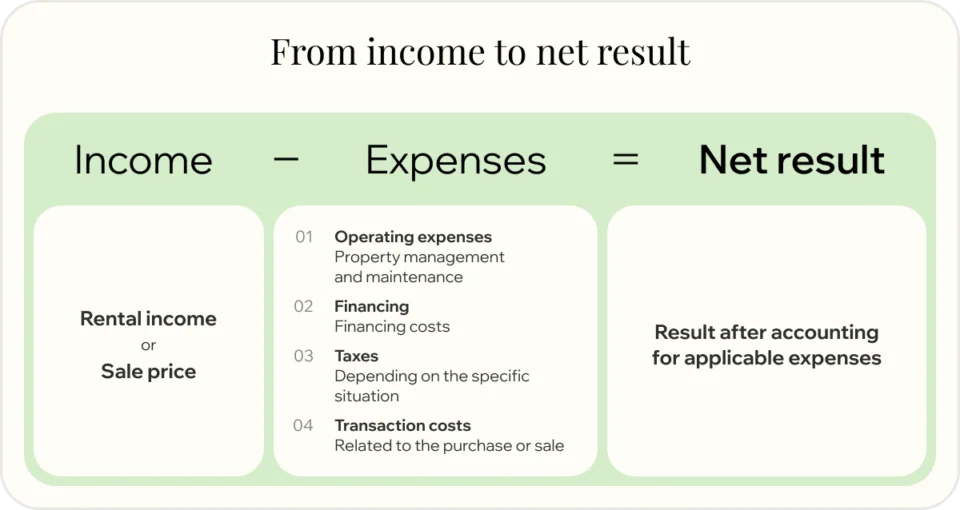
The real profit from a real estate investment is not simply the rental income or an increase in the property’s value, but the amount left after all costs, taxes, and fees have been deducted.
Gross yield shows the relationship between rental income and the purchase price. Net yield takes into account maintenance, management, repair, and tax costs. After-tax cash flow, in turn, answers the most practical question: how much money actually remains for the investor after ongoing obligations and financing have been paid.
When selling, the calculation also includes entry costs, exit costs, and capital gains tax. Without these items, even an attractive-looking project may deliver a lower net result than the rental offer suggests.
MAG World Properties helps organize purchase costs and project data across different countries, but an individual tax settlement should always be confirmed with a qualified advisor familiar with the relevant jurisdiction and the investor’s situation.
Book a consultation. Exact taxes, fees, and conditions should be confirmed for the specific country, city, ownership structure, and purpose of purchase.
Rental Taxation: Which Reporting Model Affects the Owner’s Income
Rental taxation depends, among other factors, on the country where the property is located, the owner’s status, the type of rental, and local rules for accounting for expenses. The key distinction is between tax on revenue and income tax on rental earnings.
Tax on rental income abroad should not be assessed solely based on the nominal rate. It is equally important whether costs can be deducted and, if so, which costs.
Tax on Revenue vs. Tax on Rental Income
A revenue tax is calculated on the total amount of rent received, without taking into account some of the owner’s expenses. Income tax, on the other hand, is charged after deducting costs that local regulations recognize as related to the rental activity.
For example, with annual rental income of EUR 20,000 and operating costs of EUR 6,000, a revenue-based model may tax the full EUR 20,000. Under an income-based model, the taxable base may be EUR 14,000, provided the expenses are allowable and properly documented.
A lower revenue tax rate is therefore not always more advantageous. For a property with expensive management, renovations, or a mortgage, an income-based model may better reflect the owner’s actual result.
Which Rental Costs May Reduce the Taxable Base
Depending on the country and ownership structure, tax-deductible expenses may include rental management, repairs, furnishings, insurance, accounting services, or homeowners’ association fees paid by the owner. In some systems, interest on investment financing may also matter.
Each expense should be documented with an invoice, contract, and proof of payment. Costs related to private use of the property should also be separated from rental business expenses. The fact that an expense was commercially reasonable does not automatically mean that it will be tax-deductible.
Taxes and Fees Beyond Rent: Purchase, Ownership, and Financing
The costs of buying property abroad begin before the keys are handed over. In addition to the property price, they may include a transfer tax or fee, notary and registration costs, legal services, and administrative charges related to the acquisition.
After purchase, recurring costs arise: property tax, local fees, insurance, homeowners’ association or property manager fees, utilities assigned to the owner, and a reserve for servicing and repairs. Their names, payment deadlines, and calculation methods differ across Spain, the United Arab Emirates, Greece, Turkey, and other markets served by MAG World Properties.
Investment financing also requires separate analysis. A mortgage payment is not always tax-deductible in full, and the possibility of deducting interest depends on local rules. When purchasing in a foreign currency, exchange rate risk should also be taken into account, especially when rental income, financing, and taxes are settled in different currencies.
Before signing a reservation agreement, it is worth separating:
- one-off costs: price, purchase taxes and fees, lawyer, registration;
- annual costs: property tax, insurance, management, and maintenance;
- variable costs: repairs, vacancies, furnishings, exchange rate differences;
- financing costs: interest, bank fees, currency conversion fees;
- exit costs: sales commission, documents, tax on the sale of the property.
Selling a Property and Capital Gains Tax
Tax on the sale of a property usually applies to the profit earned, but the method of calculation is determined locally. The purchase price, documented expenditures, holding period, transaction costs, and any exemptions available in the relevant country all matter.
The timing of the sale can change the net result of the investment. You should not assume that rules familiar from Poland will work in the same way when selling property abroad.
How to Determine the Taxable Base on Sale
The taxable base is most often determined by comparing the sale price with the acquisition cost increased by qualifying expenses. The calculation may include purchase costs, transaction fees, sales commission, and documented upgrades that increase the property’s value.
Ordinary ongoing maintenance, such as minor repairs or utility bills, is not always treated in the same way as capital improvements. For this reason, it is worth archiving notarial deeds, contracts, invoices, bank transfer confirmations, and documentation of works from the date of purchase.
Before a planned sale, local rules should be confirmed with a tax advisor rather than basing the decision on general information found online.
Tax Residency and Double Taxation Treaties
Tax residency determines the country in which an investor generally reports their worldwide income. Rental income or profit from the sale of foreign property may be taxable in the country where the property is located while also requiring reporting in the investor’s country of tax residency.
Double taxation treaties are intended to limit situations in which the same income is effectively taxed twice. However, they do not automatically eliminate reporting obligations in Poland. The settlement method depends on the specific treaty and the type of income.
How to Calculate After-Tax Profit Before Buying
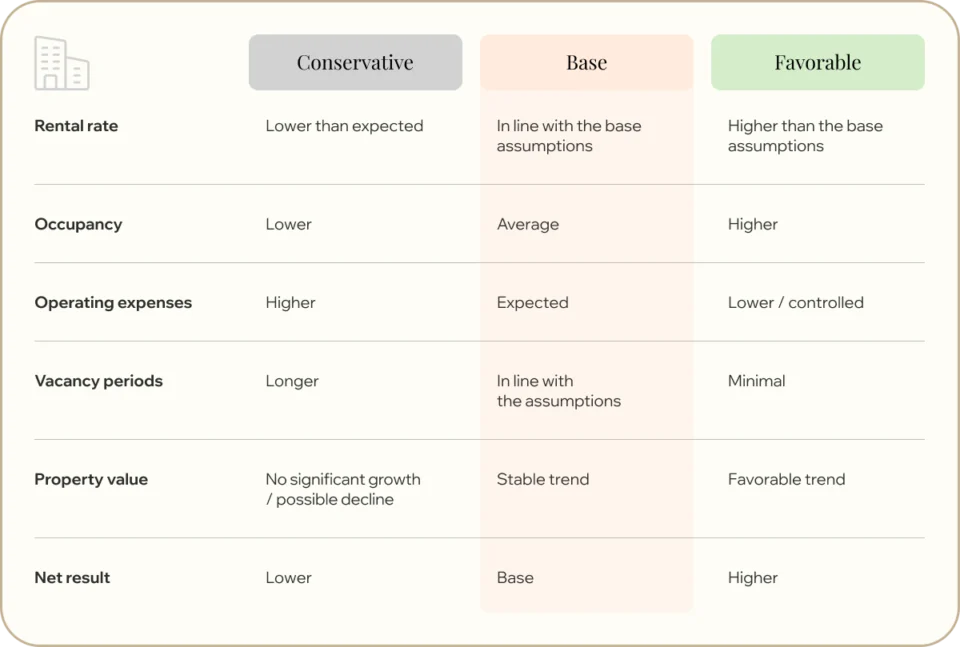
A real estate profit calculation should be based on three scenarios: cautious, base, and favorable. Its purpose is not to promise a return, but to compare investments under different assumptions relating to rentals, vacancies, costs, and sale.
Confirmed data, such as the purchase price or fees stated in the project documentation, should be clearly separated from assumptions, such as future rental levels or exchange rates.
Items That Should Be Included in the Net Calculation
First, enter the planned rental income, then subtract vacancies, discounts, and periods without a tenant. The next stage is to account for management, maintenance, insurance, financing, taxes, and a repair reserve.
|
Item |
Assumption |
Annual Cost |
Impact on Net Result |
|
Rental income |
planned rent |
– |
increases the result |
|
Vacancies and discounts |
cautious assumption |
variable |
reduces the result |
|
Management and maintenance |
contract or estimate |
fixed/variable |
reduces the result |
|
Investment financing |
interest and fees |
variable |
reduces the result |
|
Local taxes and fees |
according to jurisdiction |
fixed/variable |
reduces the result |
|
Repair reserve |
own assumption |
variable |
reduces the result |
Purchase and sale costs should be spread over the entire expected investment period. Omitting them often overstates the profitability of a real estate investment.
Depreciation, Reinvestment, and the Limits of Legal Tax Optimization
Depreciation is the tax recognition of an asset’s wear and tear over time. In some systems, it may reduce the taxable base for rental income, but the rules depend on the country, type of property, and owner’s status.
Reinvesting profits from a sale into another property is a capital allocation decision, not an automatic tax exemption. Any reliefs, deferrals, or special conditions should be checked before the transaction, not after it has closed.
Legal real estate tax optimization involves using solutions provided for by law, maintaining complete documentation, and filing returns on time. Sham transactions or actions inconsistent with the actual course of the transaction may create tax and legal risks.
What to Check Before Buying Property Abroad and When to Consult a Tax Advisor
Before buying property abroad, it is worth gathering all information into one calculation instead of analyzing the price, rental income, and taxes separately. Particularly important factors include the ownership structure, total purchase cost, rental rules, annual charges, taxation on sale, and obligations resulting from tax residency.
A practical list of questions before making a reservation should include:
- What taxes and fees are due upon purchase?
- What property maintenance costs does the owner bear each year?
- How are short-term and long-term rentals taxed?
- Does local law allow management, repair, or financing costs to be included?
- How does capital gains tax work upon sale?
- Which tax returns must be filed in the country where the property is located and in Poland?
- Which data are confirmed in the project documents, and which remain projections?
MAG World Properties supports clients in selecting a country, city, and new-build project, as well as in organizing the purchase process with local lawyers. The agency’s services are paid for by developers, so the investor does not pay a commission for MAG World Properties support. However, real estate tax advice and an individual tax settlement should be confirmed by a licensed tax advisor familiar with both systems.
The safest next step is an investment consultation regarding a specific location and purchase objective. It makes it possible to compare not only project prices, but also the total cost of ownership and the tax implications of renting and a future sale.
*This material is for informational purposes only and does not constitute individual tax, legal, or investment advice. Regulations and authority practices may change, so current conditions should be confirmed through official sources and with authorized professionals before making a decision.*
Frequently Asked Questions
Is rental tax calculated on revenue or income?
It depends on the country and the available reporting model. Tax may be calculated on the full rent or on income after allowable costs have been taken into account.
Which costs can be included when selling a property?
The purchase price, transaction costs, and documented expenditures are usually important. The scope of expenses recognized for tax purposes depends on local regulations.
Does reinvesting money from the sale of a property eliminate tax?
No, reinvestment does not automatically eliminate tax. Any reliefs or deferrals apply only when the conditions of the specific tax system are met.
Does depreciation always reduce tax on investment property?
No, depreciation is not always available or calculated in the same way. The rules depend on the country, type of property, and the owner’s tax status.
When is it worth consulting a tax advisor about an investment?
Ideally, before signing a reservation agreement or purchase contract. A consultation is particularly necessary in relation to rentals, financing, sale, and reporting income in more than one country.